Single / Post
- Posted Date:
- Dec 25, 2022
- Category:
The Crown on Netflix: Do You Know These Words?

This lesson starts a new series based on well-known Netflix shows, beginning with The Crown, the drama about the British royal family. It's packed with idioms and more demanding expressions that challenge learners at higher levels, and history and royalty rarely come up in school English. Series and films on a particular subject are a goldmine of advanced vocabulary. The Crown has the refined language of the elite, but also plenty of expressions you can use in everyday life to make your English richer.
Before we start, get to know the basic vocabulary of the British monarchy.
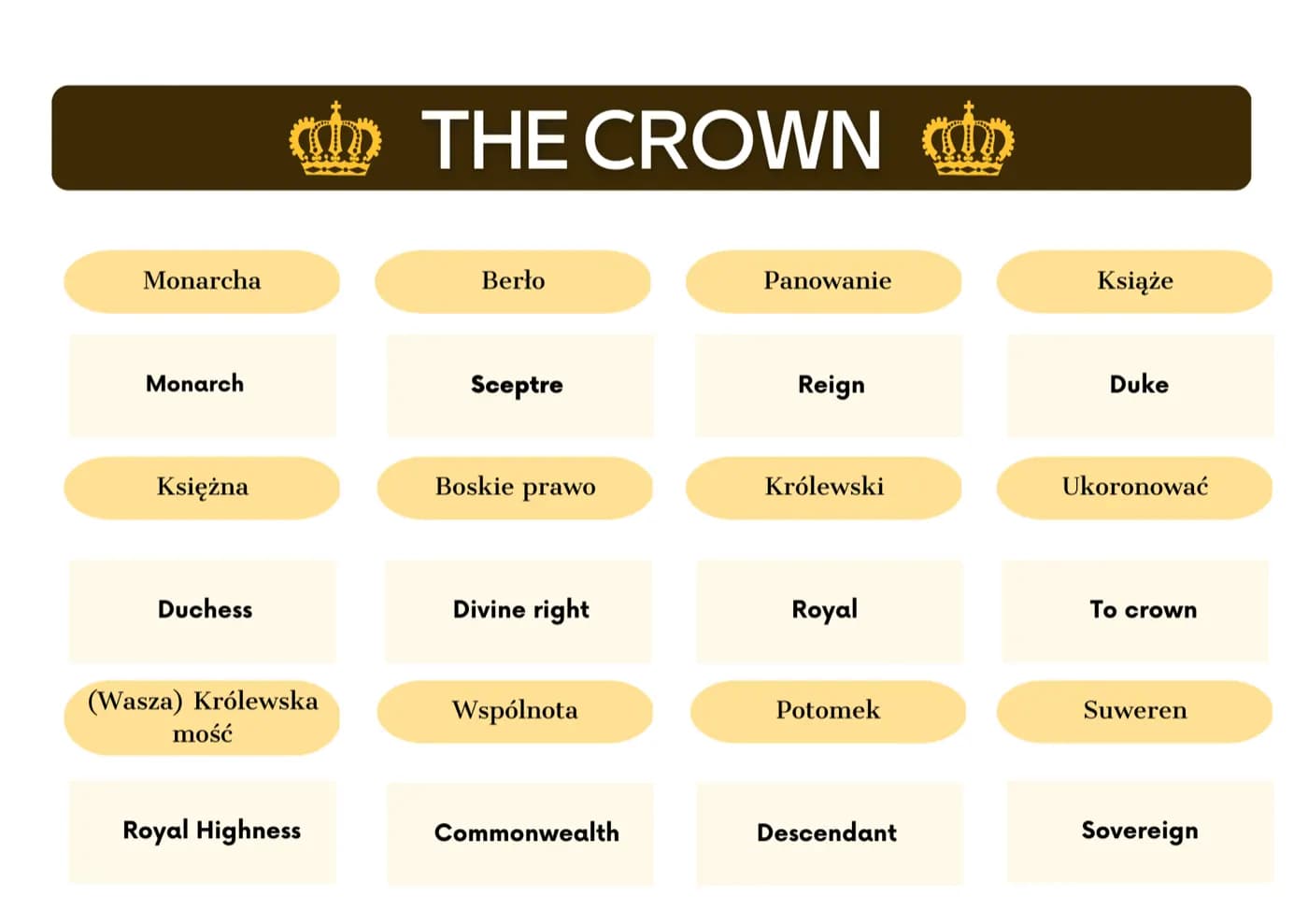
Exercise 1: match the words a to l with the definitions 1 to 12
- a. Monarch
- b. Sceptre
- c. Reign
- d. Duke
- e. Duchess
- f. Divine right
- g. Royal
- h. To crown
- i. Royal Highness
- j. Commonwealth
- k. Descendant
- l. Sovereign
- 1. a title used to address a royal person.
- 2. a member of the royal family.
- 3. a nation's ruler, usually by hereditary right.
- 4. a sovereign head of state, especially a king or queen.
- 5. a person considered as coming from some ancestor.
- 6. an ornamented staff carried by rulers on ceremonial occasions as a symbol of sovereignty.
- 7. a political system in which power lies with a body of citizens.
- 8. to place a crown on someone's head in a ceremony to make them monarch.
- 9. to hold royal office; to rule as monarch.
- 10. a man holding the highest hereditary title in the British and certain other peerages.
- 11. the right supposedly given to a king or queen by God to rule a country.
- 12. a woman holding a rank equal to a duke in her own right.
Scene 1: Elizabeth and her tutor
Let's start our journey with a scene from season 1, episode 7, "Scientia Potentia Est". Watch it before you read on: watch the scene.
The storyline: the young Queen feels her limited education leaves her unable to hold her own with clever statesmen, so she takes lessons from a private tutor, Professor Hogg. Meanwhile, Churchill suffers a stroke and he and his ministers keep it from her so that he can stay in office. When she learns the truth, she has to decide whether to confront some of the most powerful men in the country. Her tutor helps her see that the confidence she needs comes from knowing the Constitution, not from a university degree.
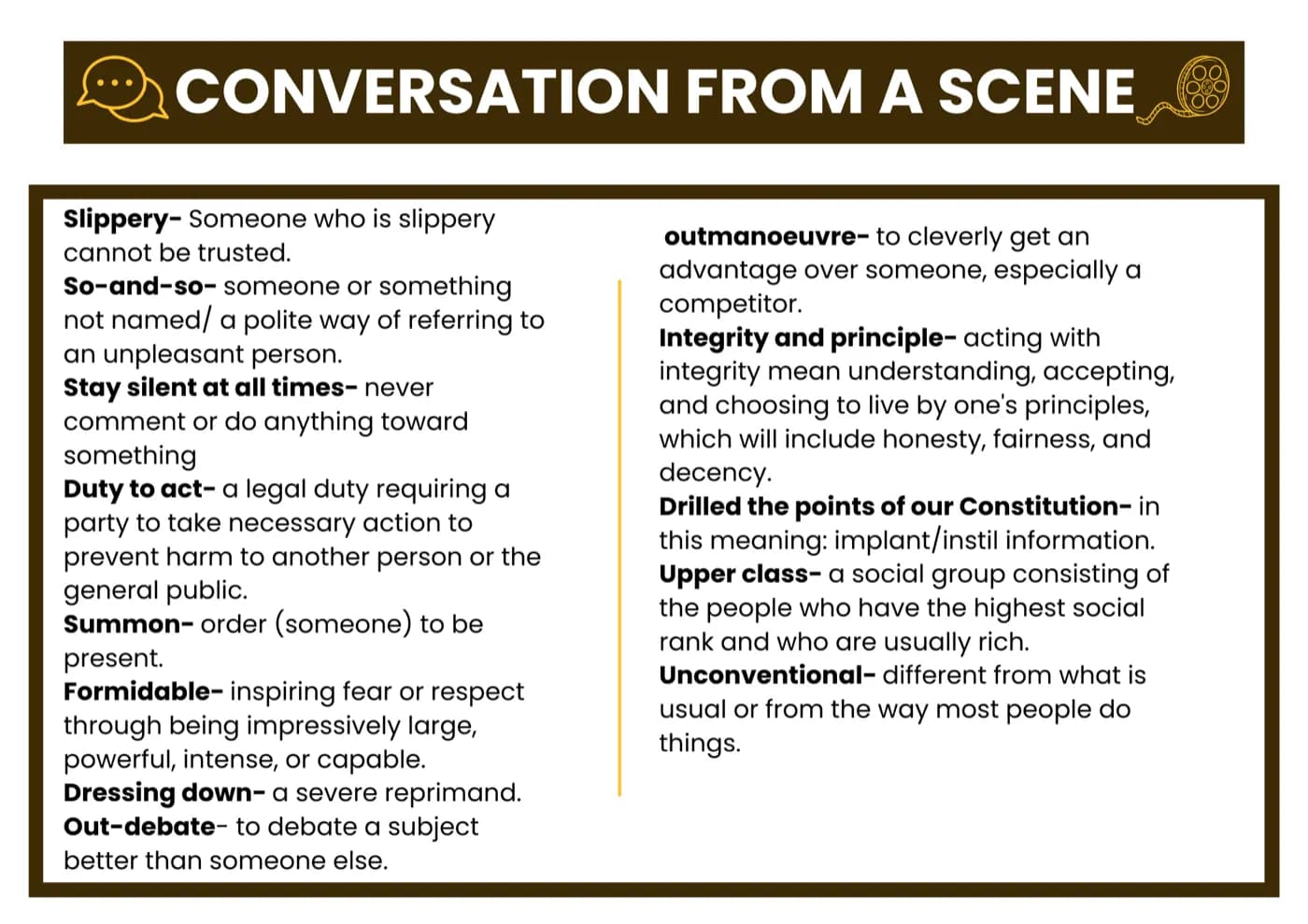
Vocabulary from the scene
- Slippery: someone who is slippery cannot be trusted.
- So-and-so: someone not named; also a polite way of referring to an unpleasant person.
- Stay silent at all times: never comment on or do anything about something.
- Duty to act: an obligation to take the action needed to prevent harm.
- Summon: to order someone to come to you.
- Formidable: inspiring fear or respect through being impressively powerful or capable.
- Dressing down: a severe telling-off.
- Out-debate: to argue a subject better than someone else.
- Outmanoeuvre: to cleverly gain an advantage over someone, especially a competitor.
- Integrity and principle: acting with integrity means understanding, accepting and choosing to live by your principles, including honesty, fairness and decency.
- Drilled in something: taught something thoroughly by repetition.
- Upper class: the social group with the highest social rank, usually wealthy.
- Unconventional: different from what is usual or from the way most people do things.
Exercise 2: fill in the gaps with vocabulary from the scene
- 1. My boss ……………… us to his office.
- 2. She assumed he was from the ……………… because he wore an expensive suit.
- 3. Everyone in this government is so ……………… They all lie!
- 4. For me, it's all about ……………… You can't undermine the basic rules.
- 5. Mr Jones was such a ………………, he was always really mean!
- 6. She felt intimidated by their ……………… behaviour.
- 7. In a crisis, our government has a ………………
- 8. You were ……………… in every paragraph of the criminal law.
- 9. We have a ……………… task ahead of us.
- 10. Even if they ……………… you and ……………… you, never give up and keep rising.
- 11. It is her role to ……………… when it comes to government actions.
- 12. She gave me a ……………… for being late.
Scene 2: the Queen's first audience with Margaret Thatcher
Now watch a scene from season 4, episode 1, "Gold Stick": watch the scene.
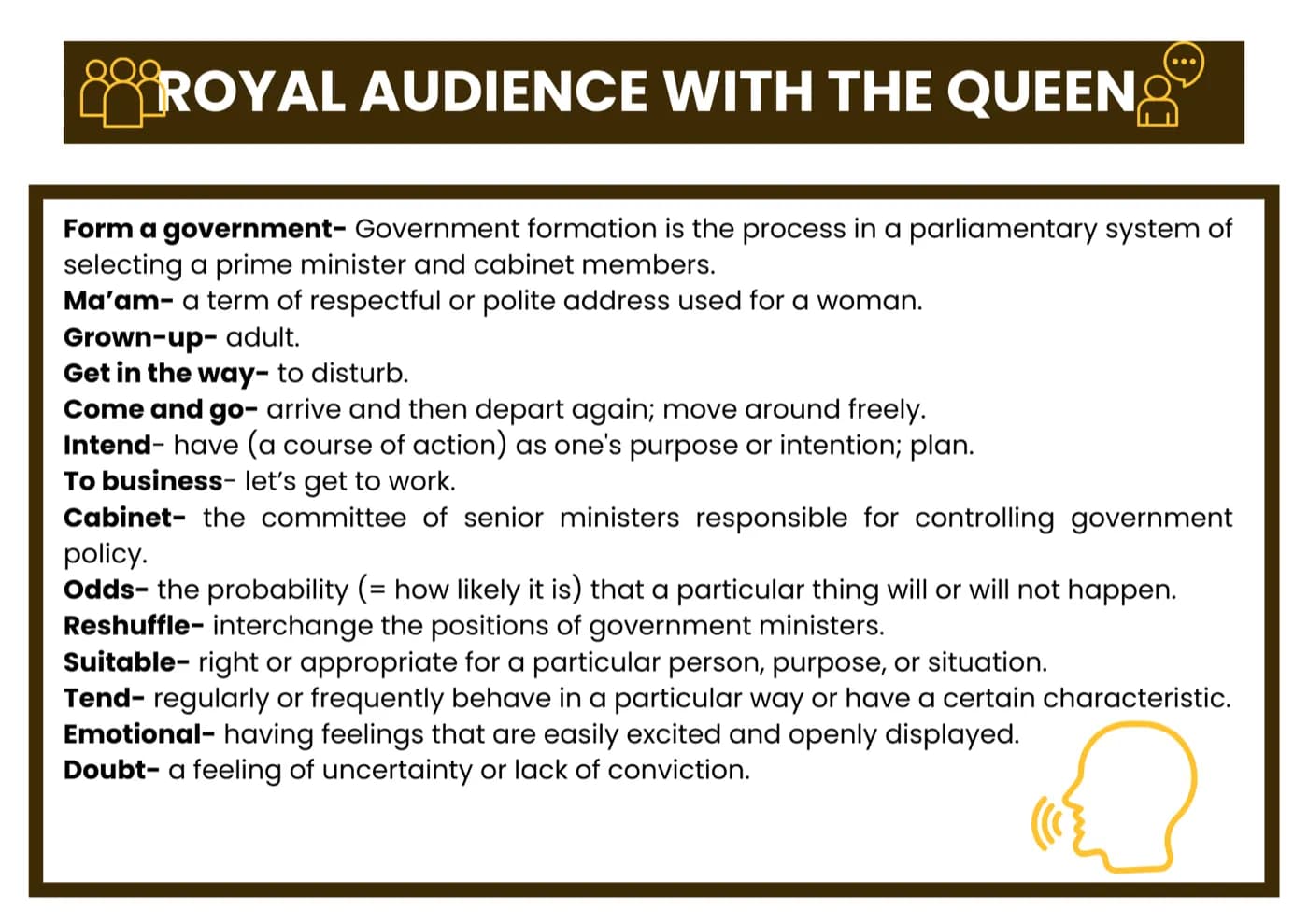
The storyline: Margaret Thatcher, newly elected as Britain's first woman prime minister, arrives at the palace for her first audience with the Queen. Notice the protocol: the Queen rings a bell as a signal, a member of staff opens the door and announces the guest, and the Queen formally invites her to form a government. The conversation then moves from polite questions about family to the new Cabinet, and to a revealing exchange about women in high office.
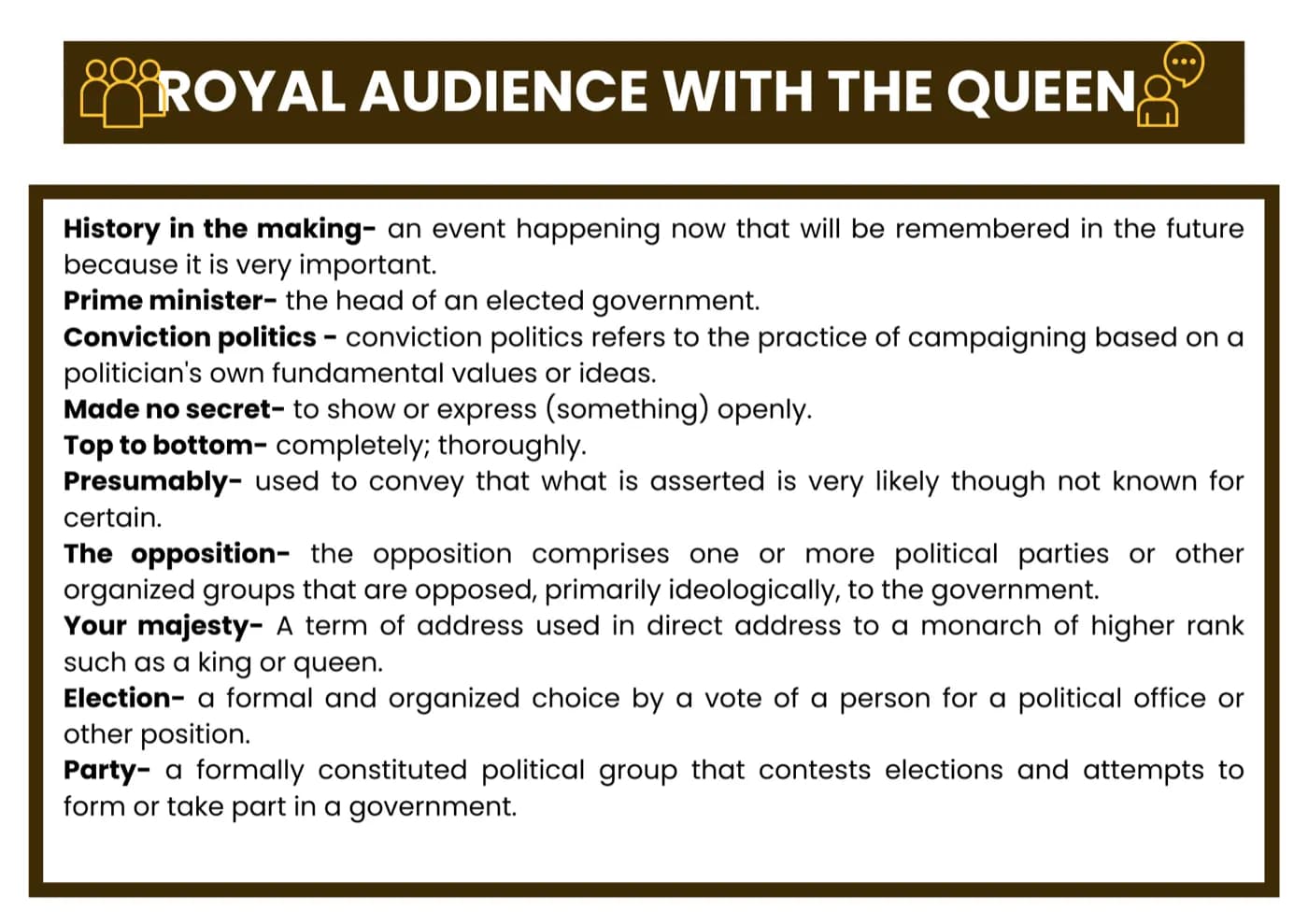
Vocabulary from the scene
- History in the making: an event happening now that will be remembered because it is so important.
- Prime minister: the head of an elected government.
- Conviction politician: a politician who campaigns on their own fundamental values and ideas.
- Make no secret of something: to show or say something openly.
- From top to bottom: completely, thoroughly.
- Presumably: very likely, though not known for certain.
- The opposition: the political parties or groups opposed to the government.
- Your Majesty: the form of address used to speak directly to a king or queen.
- Party: an organised political group that contests elections and tries to form or join a government.
- Election: an organised choice, by vote, of a person for a political office or other position.
- Form a government: in a parliamentary system, to choose a prime minister and cabinet members.
- Ma'am: a respectful or polite way of addressing a woman.
- Grown-up: adult.
- Get in the way: to disturb or be an obstacle.
- Come and go: to arrive and leave again; to move around freely.
- Intend: to plan or mean to do something.
- To business: let's get to work.
- Cabinet: the committee of senior ministers responsible for government policy.
- Odds: how likely it is that something will or won't happen.
- Reshuffle: a change in the positions of government ministers.
- Suitable: right or appropriate for a particular person, purpose or situation.
- Tend to: to regularly behave in a particular way or have a certain characteristic.
- Emotional: having feelings that are easily stirred and openly shown.
- Doubt: to feel uncertain about something.
Exercise 3: listen for the words
Watch the audience scene again and tick each word from the list above as you hear it. Then write down the full sentence in which each one appears. Check your sentences against the English subtitles of the scene.
The Crown brings both politics and everyday problems close to the viewer in a very engaging way. To use C1 and C2 expressions fluently, you need to keep listening and keep adding new words and phrases to your vocabulary, and series and films make it much easier to master the vocabulary of a particular field. If you'd like more political jargon, I recommend House of Cards, which shows an American view of politics and the fight for the highest offices in the country. See you in the next lesson!