Single / Post
- Posted Date:
- Oct 23, 2022
- Category:
How Many Words Do You Need to Speak English Fluently?

Imagine you've been invited to a job interview. Everything is going well: strong references, seven different courses behind you, plenty of creativity. Then comes the question most candidates dread: "How good is your English?" Doubt creeps in, because you have no idea how to rate yourself. You may even feel annoyed with yourself for all the times you promised to study, sign up for a course or do anything that would let you sit confidently in that chair. You could say you know English "to some extent", but you'll quickly realise that says very little. You could also do one of three things:
- give your level on the CEFR scale: A1, A2, B1 and so on (if you know it),
- describe what you can do in the language,
- describe your general language skills.
Better still, read this article and learn how to describe your level precisely, so an employer knows exactly what to expect from you.
You don't need to learn every word in the dictionary
Some linguists believe that just 800 words are enough for a basic conversation. Is that true? How many words do you really need to speak English well? And how many to get a promotion, land a great job at an international company or go on business trips abroad? 800, 2,000, 11,000, or the whole dictionary?
You don't need every word in a language to use it fluently, and language learning experts agree on this. Fluency means speaking freely. It's the point where everything "clicks" and you stop pausing to think about pronunciation, grammar or vocabulary in order to get your message across.
Notice that in your first language you experience almost perfect fluency. Listen to yourself and you'll see that you rarely think about which words to use. You decide to say something and you say it, with whatever words come naturally.
When you learn a language, that fluency develops gradually. A good sign is that you stop translating in your head. At first, translating is completely normal, but with practice speaking becomes automatic and the words are ready when you need them. That's when you start enjoying easy conversations with native speakers and sorting out anything you need abroad without effort. Feeling confident talking to someone whose first language you are learning is an amazing feeling.

How do you start speaking English fluently?
Do you remember how you learned English at school? If you're reading this, you may well be a product of the traditional (read: old) approach to language teaching. Traditional school methods focus on formal aspects such as grammar rules, word order and verb forms.
According to that approach, learning all of this helps you express yourself better and avoid mistakes. Less traditional methods assume that the foundation of communicating in a foreign language is, above all, a rich vocabulary. Think of it this way: will you get more across with correct grammar and few words, or with lots of expressions that you don't always use perfectly?
I'm not trying to convince you that you can skip the rules of building sentences. My point is that vocabulary is the foundation of a language, and if you add practised ways of combining words, you reach the fluency you want. Being a grammar expert doesn't always mean speaking fluently. Fluency is more than memorising rules or new words. The aim of learning a language isn't to learn formulas but to be able to use it.
How many words do you need to be fluent?
When you read English texts or listen to native speakers, do you feel they must have swallowed a million-page dictionary? That's a very common feeling among learners. Think of words as LEGO bricks: you don't need that many to build a beautiful palace. So it's worth knowing how many bricks, or English words, you'll need to reach your goal.
How many words does an average native speaker know? Exact numbers are hard to pin down, and no panel of linguists has given a final verdict, but around 20,000 is typical for a well-educated English speaker.
According to some sources, the levels look like this:
- 250 words are the core of the language, the pieces without which you can't build any sentence.
- 750 words are the ones every speaker of the language uses every day.
- 2,500 words should let you express everything you want to say, though with a high risk of awkward phrasing.
- 5,000 to 10,000 words make up the active vocabulary of native speakers with different levels of education.
- 20,000 words let you read, understand and enjoy literature, such as novels by well-known authors. Many of these words are passive: you recognise them when you see them written.
What does that mean for your goals?
Find the level you want to reach and see roughly how many words you'll need:
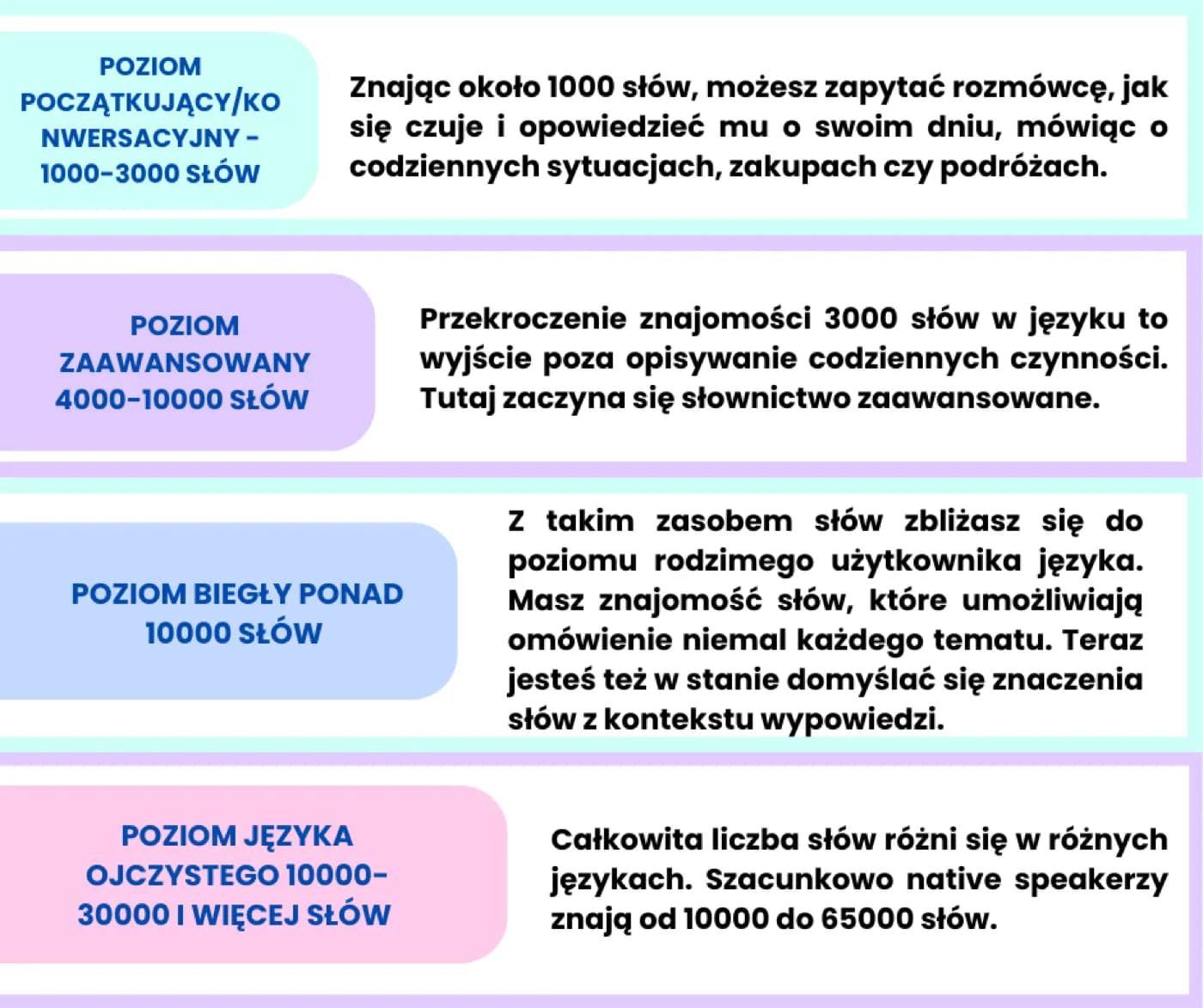
- Beginner to conversational, 1,000 to 3,000 words: with about 1,000 words you can ask someone how they are and tell them about your day, talking about everyday situations, shopping and travel.
- Advanced, 4,000 to 10,000 words: going beyond 3,000 words takes you past describing daily routines. This is where advanced vocabulary begins.
- Proficient, over 10,000 words: you're approaching native level and know enough words to discuss almost any topic. You can also guess the meaning of words from context.
- Native level, 10,000 to 30,000 words and more: the total varies between languages, and estimates for native speakers range from 10,000 to 65,000 words.
How can you measure your vocabulary?
The language specialists Paul Nation, John Read and Robin Goulden created a test to check real vocabulary size. It's based on just 50 words, a tiny sample compared with the more than 200,000 words in English. The rule is simple: from the list of 50 words, tick the ones you know, then multiply that number by 500. The result is roughly the size of your English vocabulary. The test is available online.
"Do you speak English well?"
For you, the number of words you know is mainly motivational. A future employer won't learn much from hearing that you know 10,000 words. Describing your skills as basic, conversational, advanced or fluent paints a clearer picture. In a job interview, it's better to say your English is:
- Basic: you know the essential phrases and can talk about simple things.
- Conversational: you can talk about everyday topics with small grammar or vocabulary mistakes, but you can't write comfortably.
- Advanced: you can express any thought without hesitation, using correct vocabulary and grammar, and people understand you easily. Both your speaking and writing are good.
- Fluent: different from advanced in how deeply you understand the structure of the language. You can explain to others how it works, use idiomatic language and tell accents apart.
What will learning vocabulary give you?
"How many words do I need to speak English?" is a question whose answer explains very little on its own. It's more useful to ask why you want to learn English, because everyone's goals differ and so does the number of words they need:
- 300 to 600 words may be enough for a weekend in London.
- To hold a conversation, you need to know and use between 1,000 and 3,000 words. With the right vocabulary you'll cope with all kinds of situations and everyday conversations, and you'll understand people and be understood when you travel. This level covers the needs of most learners.
- To work or study abroad at an advanced level, you'll probably need 6,000 to 10,000 words.
- And if you want to speak as fluently as a native speaker, you'll need 10,000 to 15,000 words.
Start with the most common words
Learning the most frequently used English words is a great way to master the language. Common words not only raise your level, they also make conversation easier. You'll soon notice that these are exactly the words the people you talk to use most often, so the effect is immediate.
Knowing the 1,000 most common English words puts you between a functional beginner and a conversational level. Write to me if you'd like a list of the 1,000 English words you need to know. Start by getting familiar with them and then use them deliberately in everyday conversations.
How do you become more fluent?
The way to improve your fluency is, above all, listening and speaking. The more you listen, the more you absorb the patterns of the language. The more you speak, the less you translate in your head. Practice lets you stop thinking about each individual word and start thinking in groups of words. A big bonus of listening to content made by someone with excellent English is that you hear the language without mistakes, and gradually you start using the same error-free structures yourself.
Learning common words is a great start, and it will also give you the push you need to reach the next levels. Before you know it, you'll be using a bigger and bigger vocabulary and understanding more and more advanced words and ideas.
Regular practice and a clear goal are what matter most in language learning. If you finally want to move forward with your English, reach your goals and fulfil your career plans, I'll be glad to help. Getting there just takes a little time, and remember: the time will pass anyway.
Bibliography
- Council of Europe, Common European Framework of Reference for Languages, level descriptions: https://www.coe.int/en/web/common-european-framework-reference-languages/level-descriptions
- BBC.
- Law, F., Mahr, T., Schneeberg, A., Edwards, J., Vocabulary size and auditory word recognition in preschool children. Applied Psycholinguistics, 2017, 38(1), 89-125.
- Pacifici, S. I., How many words do you need to speak a language? beSpacific, May 2022.
- Feng, J., Webb, S., Learning Vocabulary Through Reading, Listening, and Viewing. Cambridge University Press, October 2019.
- Read, J., Nation, P., Some Issues in the Testing of Vocabulary Knowledge. May 1986.
- Nation, I. S. P., Learning Vocabulary in Another Language. Cambridge University Press, 2012.