Single / Post
- Posted Date:
- Jan 22, 2023
- Category:
Ecology: English Vocabulary for Talking About Climate
Ecology and modern ways of looking after our planet come up constantly in public debate. Governments raise the subject of green solutions that aim to limit climate change and its effects. We can see the weather changing outside our own windows: winters are much milder than they were ten years ago. Something is clearly shifting, and the responsibility for healing the planet lies with us, because people did most of the damage. Mass deforestation, intrusion into animals' natural habitats and industrial pollution all contribute to the state of the Earth today.
In this lesson we look at ecology and the challenges ahead. With the vocabulary and phrases below, you'll be able to take part in one of the most important debates of our time.
Climate change
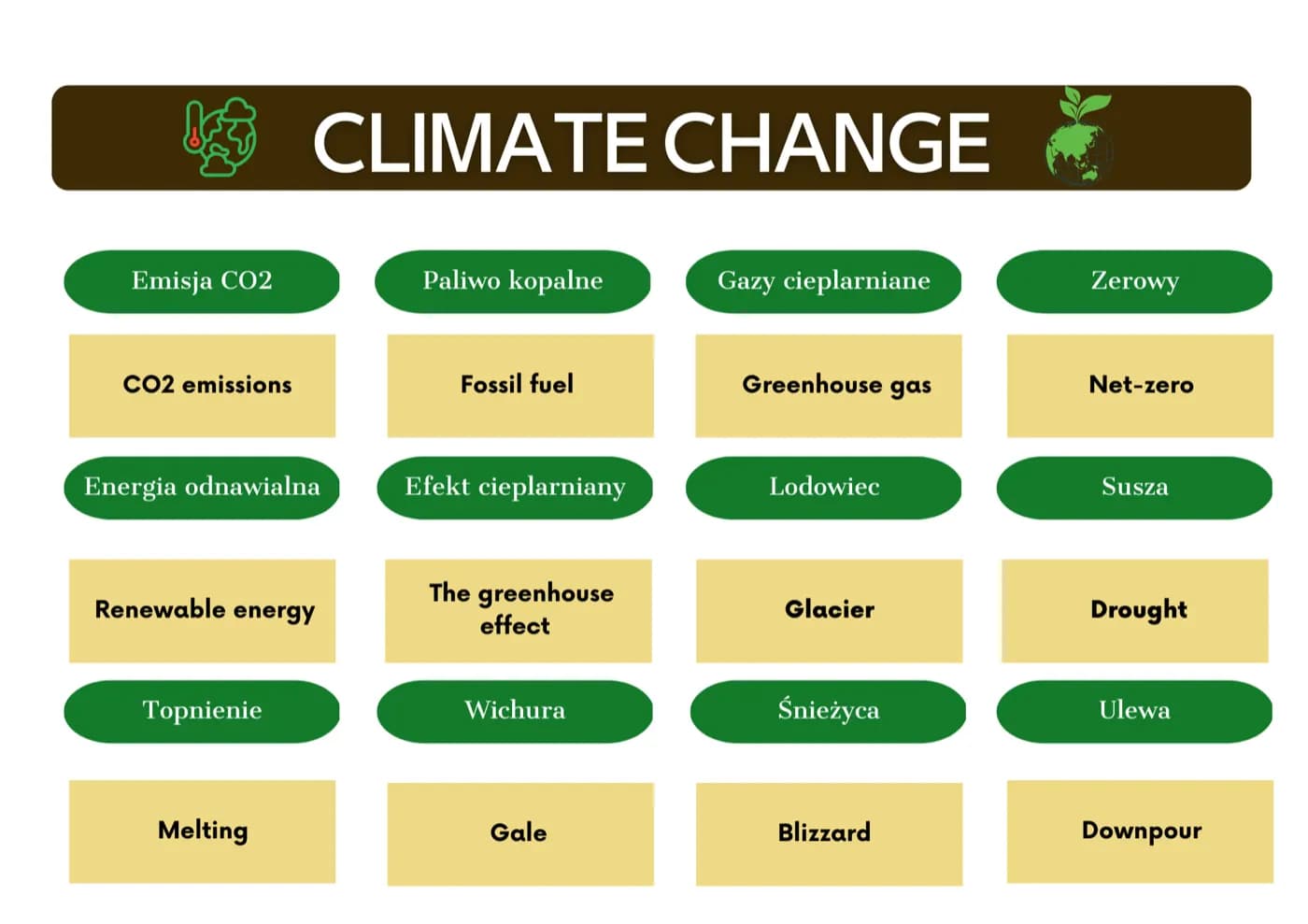
Climate change has many causes and serious consequences. Study the vocabulary below and use it to fill in the gaps.
Exercise 1
CO2 emissions / fossil fuel / greenhouse gas / net zero / renewable energy / the greenhouse effect / glacier / drought / melting / gale / blizzard / downpour
- The destruction of forests is contributing to …..
- If we can move away from ….. we might hold back warming sea temperatures.
- The world's ….. are shrinking and disappearing faster than scientists thought.
- National plans and targets for increasing the number of ….. energy buildings.
- Heavy rain and strong ….. are also expected from tomorrow.
- In the base case, ….. in the year 2032 are 2.16 billion tons.
- The research examines enormous implications such as rising sea levels, river flooding and sewerage flooding after …..
- Clean ….. is critical if we are to tackle global warming.
- The ….. caused major hardship for farmers this year.
- Overnight the rain turns to snow, which turns into a heavy …..
- There is no doubt that extra ….. in the atmosphere will warm the Earth.
- Due to the high temperatures we can observe an increased ….. process in the Arctic.
Interview with a climate activist
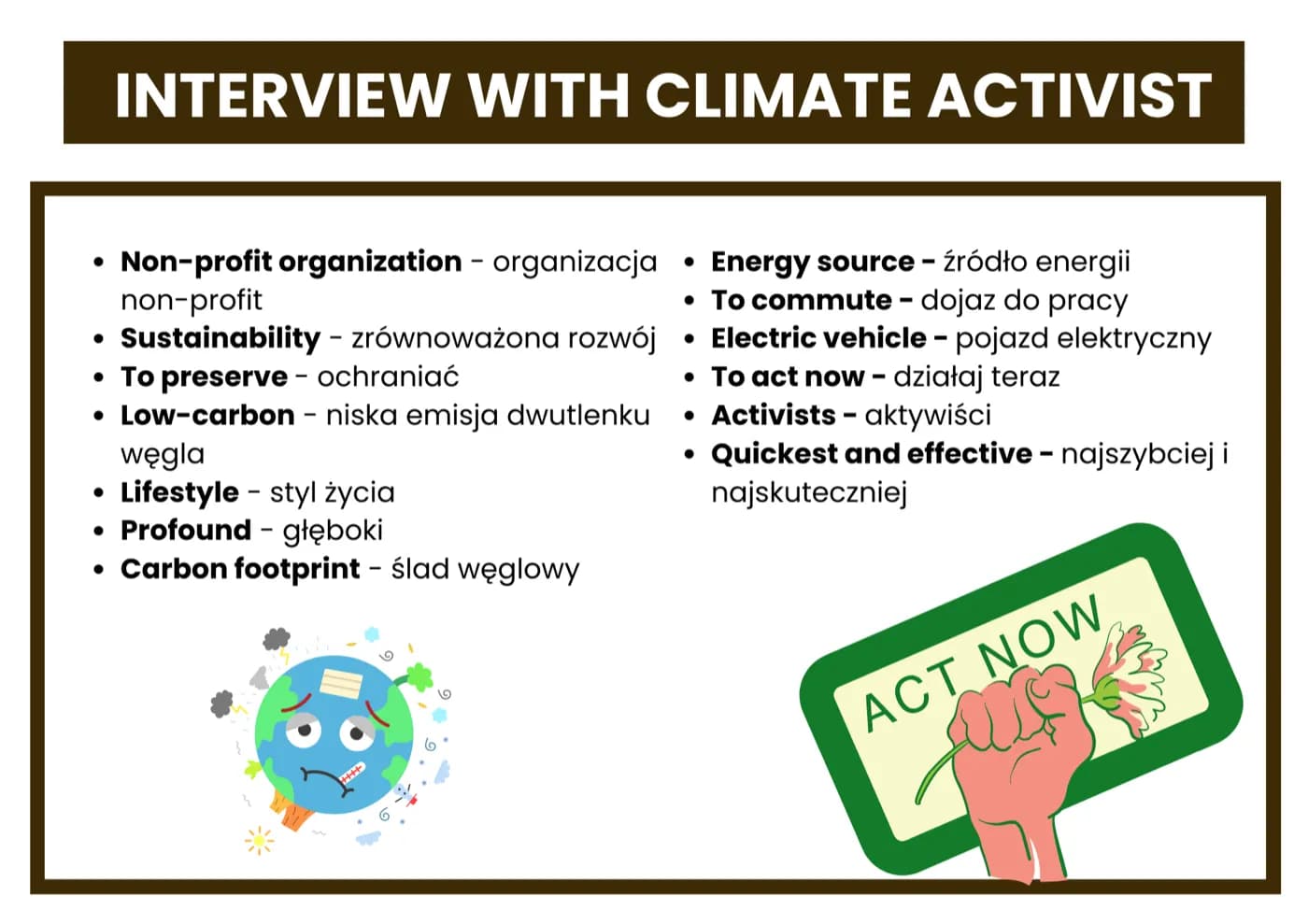
Below is part of an interview with a climate activist. Play the recording below and fill in the missing words.
Exercise 2
Recording: interview with a climate activist
Interviewer: Today, we are welcoming a special guest. Marie is an activist from the "We Love Earth" ….. We are going to discuss the campaign Act Now for individual action on climate change and …..
Activist: Thank you for having me. I am more than happy to be here tonight. To ….. a livable climate, greenhouse gas emissions must be reduced by half by 2030 and to ….. by 2050. The transition to a ….. world requires our individual participation, especially in developed countries.
Interviewer: How does our ….. impact the planet?
Activist: The way we live has a ….. impact on the planet. We make choices every day, and some of them contribute more or less to our …..
Interviewer: What is a carbon footprint?
Activist: A carbon footprint is the total amount of ….. that are generated by our actions. About ….. of the world's greenhouse gas emissions can be traced back to private ….. The electricity we use, the food we eat, the way we travel and the things we buy all ….. how much of a carbon footprint we produce.
Interviewer: How do I know how big a carbon footprint my household produces?
Activist: It is easy to check. There are many websites where you can ….. for free.
Interviewer: What actions should we ….. to prevent climate change?
Activist: You can save energy at home by changing your ….., using a bike or public transport to ….., throwing away less food, switching to an ….. and speaking up.
Interviewer: Speaking up?
Activist: Yes! Speak up and get others to join in taking action. It is one of the ….. and most ….. ways to make a difference.
Interviewer: I hope everyone can take a lesson from this ….. conversation and start to ….., because the planet can't wait.
Activist: Thank you. If you want to join our ….., you can sign up on the website or contact us directly on our Facebook page.
Source: https://www.un.org/en/actnow
Recycling
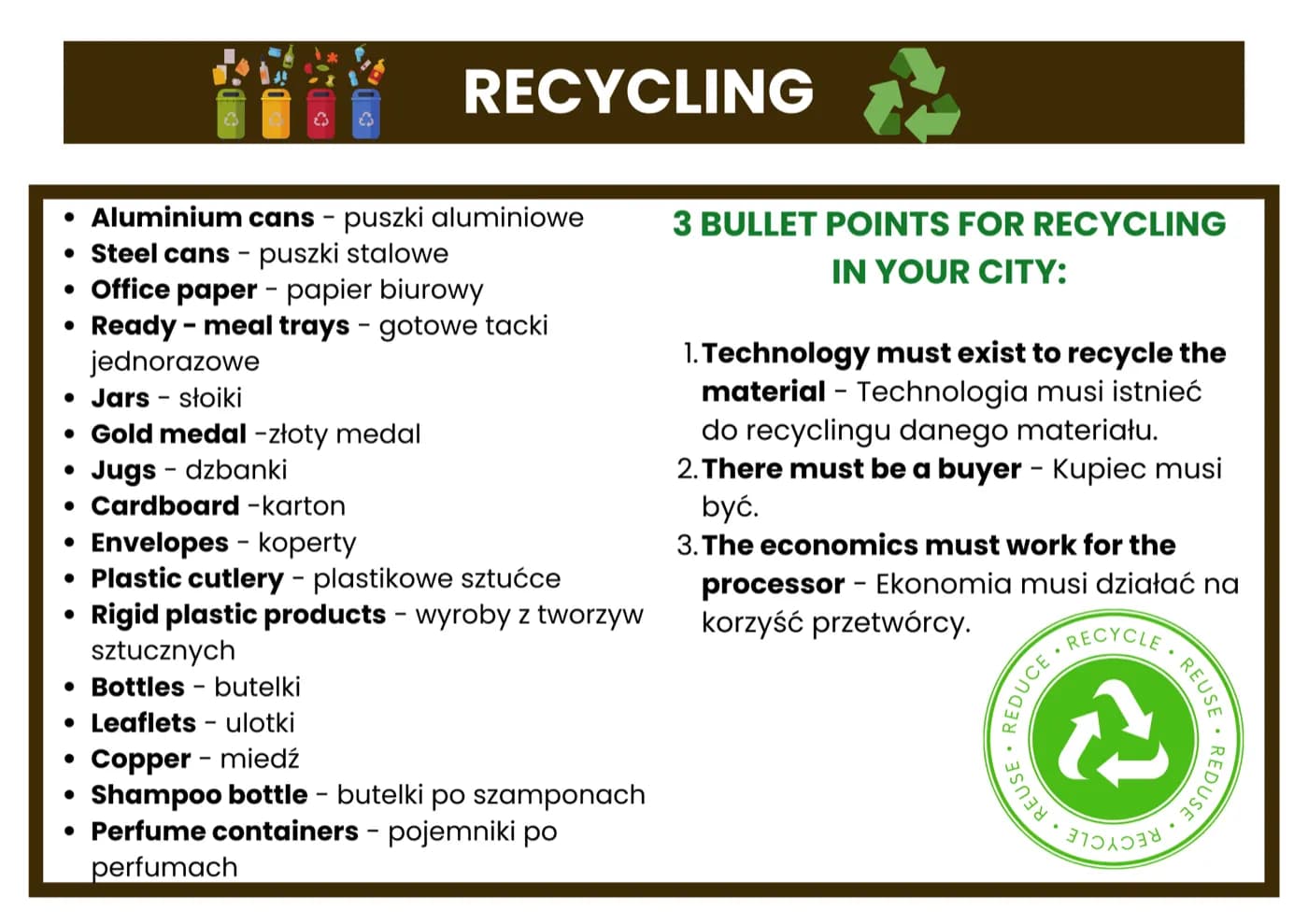
Recycling is one of the most popular ways of caring for the planet, and it has become very easy, because recycling bins are everywhere. In recent years recycling and being "eco" have also become something of a trend. Read the text below and do the exercise.
There is a well-known saying:
“ Reduce, Reuse, Recycle “
How do you understand this saying? For an item to be recyclable in your city, three key conditions must be met.
The technology must exist to recycle the material
Not every material can be reused and processed. General rubbish, food waste, tissue paper and much more can't be recycled, which means we can't make anything new out of them. However good recycling sounds, we still lack the technology to reuse every material.
There must be a buyer
Recycling is a business, and in the end there has to be a buyer for recycled goods. The recycling industry is an economic engine, providing over 500,000 jobs in America and generating more than $100 billion in revenue. The metal, paper, plastics, electronics, textiles and glass in the recycling stream are inherently valuable.
The economics must work for the processor
Some markets for recyclable materials are strong enough to pay for recovering them and turning them into new products. Recycled steel from cars and appliances is one of the most profitable post-consumer materials. Demand for other products is less predictable. Plastics are hard to recycle economically because there are so many types, and most are costly to clean and return to a usable form. Paper is not that difficult to recycle, but the market for recycled paper has changed a lot in recent years.
Exercise 3
We sort recycling into four main bins: paper, plastic, glass and metal. Put each item in the right bin.
aluminium cans / steel cans / office paper / ready-meal trays / jars / gold medal / jugs / cardboard / envelopes / plastic cutlery / rigid plastic products / bottles / leaflets / copper / shampoo bottle / perfume containers
- PAPER
- PLASTIC
- METAL
- GLASS
Ecology will come up in public discussion more and more, because it affects every one of us. The health of our planet depends on a shared human effort. How do you help protect the climate?