Single / Post
- Posted Date:
- Oct 11, 2022
- Category:
At School: Classroom Vocabulary in English

With October comes a new series about school and university. We have all been to school and used the objects and phrases I'll cover here. School vocabulary is often where English lessons begin, and education comes up in almost every coursebook. Yet many of these words aren't only useful at school: we meet the same objects in everyday life.
We'll start with classroom objects. What counts as a classroom object? Pretty much everything, from stationery to parts of the school building.
Classroom objects
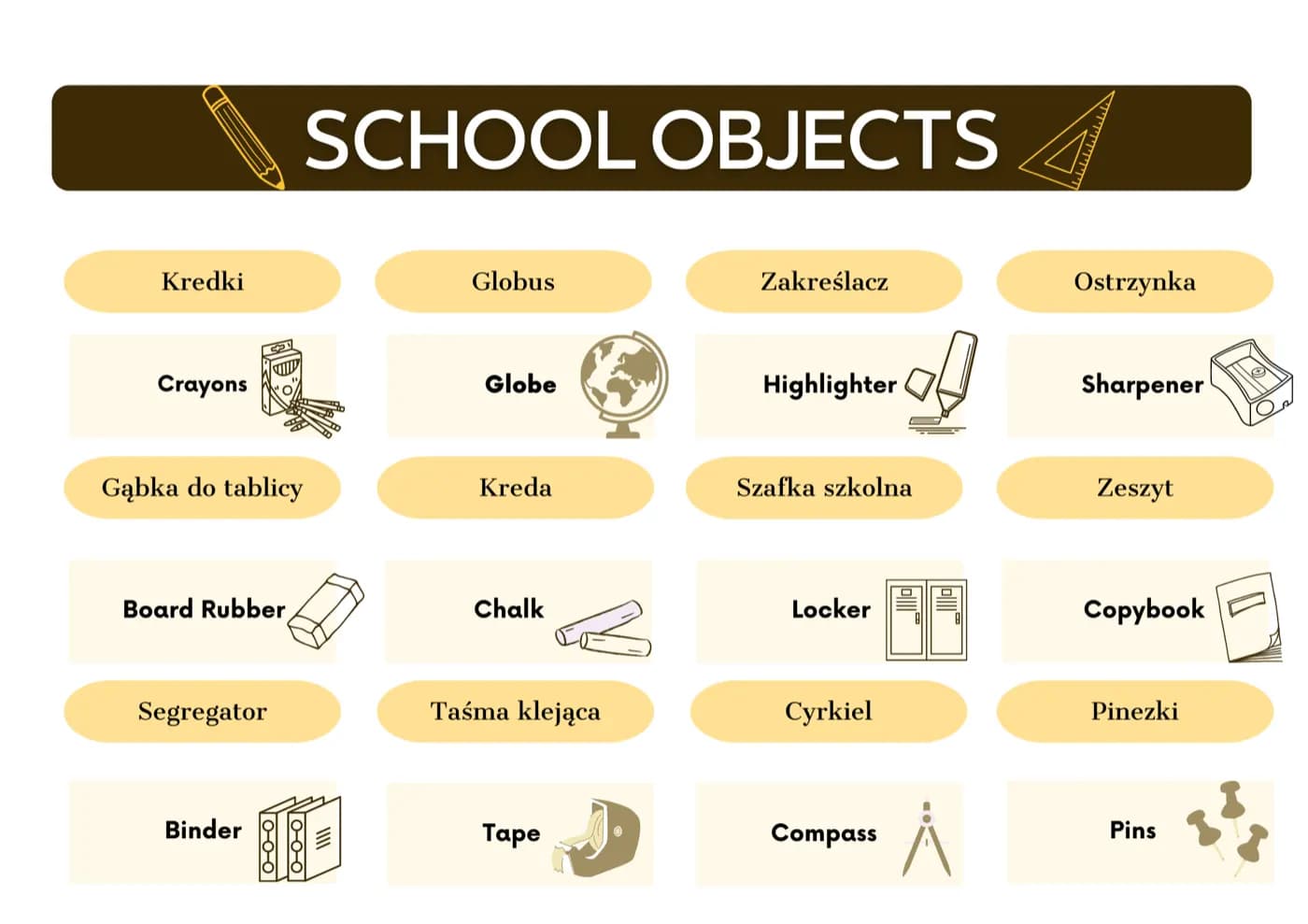
- Crayons: we use them to draw and colour. They come in different colours and sizes.
- Globe: a spherical model of the Earth. You'll see one in geography lessons.
- Highlighter: one of my favourites, because I can mark all the important information, in different colours too.
- Sharpener: if you have a pencil, you need a sharpener to sharpen it.
- Board rubber (US: eraser): used to wipe chalk off a blackboard.
- Chalk: a white stick used to write on the board.
- Locker: students use it to keep their personal things at school.
- Copybook: a book with models of handwriting for learners to copy.
- Binder: a cover for holding magazines or loose sheets of paper together.
- Tape: a narrow strip of sticky material used to hold or fasten something.
- Compass: used in maths lessons to draw perfect circles.
- Pins: used to put notes up on a pinboard.
Now play the recording below and repeat the words out loud.
Recording 1: classroom objects
Exercise 1: types of schools
When we talk about school, there are different types of schools, and each one ends with a different qualification. Read the text about the Polish school system and fill in the gaps with the words below.
“ vocational school / state school / private school / primary school / middle school / high school / technical school / degree / certificate / vocational exams / university / PhD / master's degree “
In Poland, all students start their education at …………………… In some cases, children go to kindergarten before compulsory education begins. After primary school, students used to attend ………………… but a change in the law ended that. Teenagers now skip this level and go straight to ………………, ……………… or ………………. After that, they can obtain a ………………. and pass school-leaving or ……………… exams. Some choose to continue their education at ……………… Depending on their financial situation, they go to either a ……………… or a ……………… school. Students finish with a ……………… after five years of study. That doesn't mean their education is over: they can continue and end up with a ……………….
School subjects
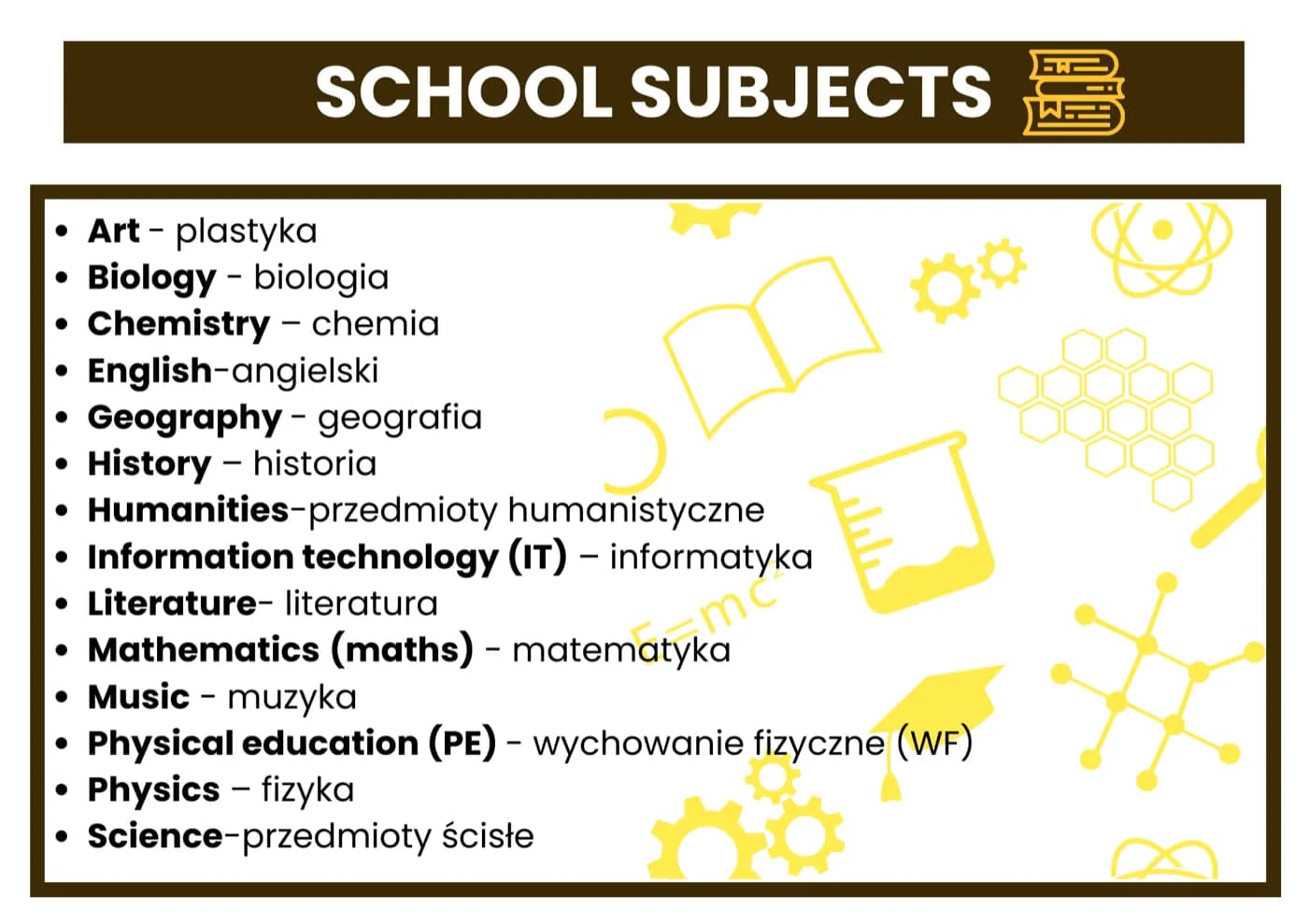
- Art
- Biology
- Chemistry
- English
- Geography
- History
- Humanities
- Information technology (IT)
- Literature
- Mathematics (UK: maths, US: math)
- Music
- Physical education (PE)
- Physics
- Science
A conversation with a classmate
Listen to the recording below and read along.
Recording 2: a conversation with a classmate
Gina: Hi Nicole, how are you? Are you ready for the new school year?
Nicole: Hi, I'm good, and yes, I'm so excited. Have you got your timetable?
Gina: Yes, I've got mine right here. Look!
Nicole: Okay, so you have PE on Mondays, just like me.
Gina: That's right. On Wednesdays I have English at eight and maths at nine.
Nicole: My timetable is a bit different. On Wednesdays I have history at nine and chemistry at ten.
Gina: What about Friday? I start with physics at eight and finish with music at quarter past one.
Nicole: Great, we're in the same physics class, but my last lesson is actually geography.
Gina: That's not bad. Do we have anything else together?
Nicole: Yes, I think we also have IT on Tuesdays at four.
Gina: You're right, I can see it. Okay, see you tomorrow in physics!
Nicole: See you!
Exercise 2: answer the questions
- What are they discussing?
- Does Gina have her timetable?
- Which classes do they have together?
- What time do they finish lessons on Friday?
- What day does this conversation take place?
Five effective ways to learn a language
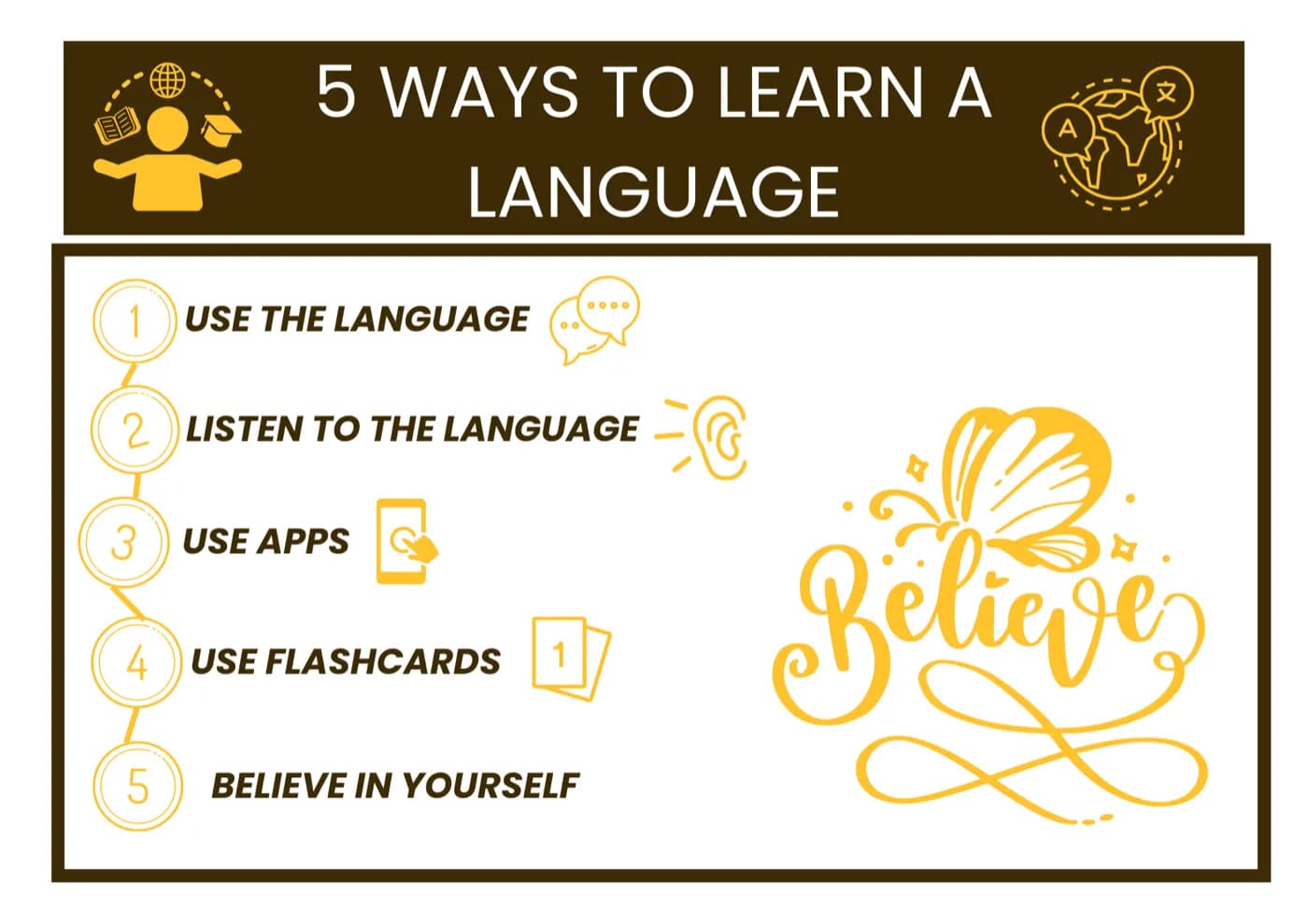
- Use the language. It sounds obvious, but many of us struggle to open up and speak another language. The best solution is simply to use it: at home, in shops, at work.
- Listen to the language. Put on YouTube, the radio or your favourite series in the original version. Start with subtitles and really tune in to what people are saying.
- Use apps. These days it's easy to find an app for learning a language or for chatting with someone in English.
- Use flashcards. Flashcards are a great way to learn new words. Make them at home with paper and a pen, or use a site like Quizlet.
- Believe in yourself. Believe that you can reach your goal and master a foreign language. And don't be afraid to ask for help and sign up for lessons with a teacher.